








SREC Registration Program
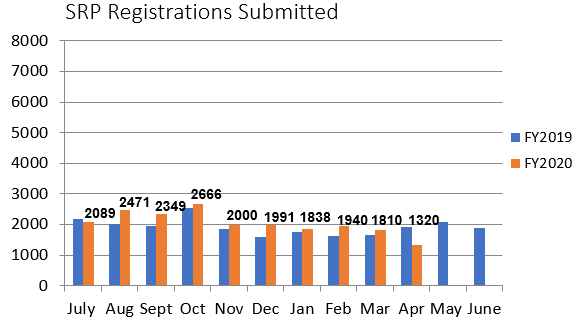
The SREC Registration Program (SRP) is used to register the intent to install solar projects in New Jersey. Registration provides market participants with information about the pipeline of anticipated new solar capacity and insight into future SREC pricing. Please note that rebates are no longer available for solar projects.
Clean Energy Act of 2018
Please be aware that to conform with the Clean Energy Act of 2018 signed on May 23, 2018, the Board has adopted rules to close the SREC Registration Program to new registrants upon the state solar electricity generation's attainment of 5.1% of retail electricity sales. The Board’s Order issued in February 2019 which estimated the 5.1% milestone would occur in April or May 2020 directed that projects seeking SREC eligibility must commence commercial operations prior to the 5.1% milestone. This Order also authorized staff to accept the Permission to Operate (“PTO”) letter issued by the Electric Distribution Company to serve as the standard for determining commencement of commercial operations. A copy of the rule adoption is provided.
.On April 6, 2020, the Board determined that the 5.1% Milestone shall be attained on or before May 1, 2020, and therefore directed TRC to close the SREC Registration Program to new registrations on April 30, 2020. Additionally, the Transition Incentive Program was established by the New Jersey Board of Public Utilities (NJBPU) to provide a bridge between the Legacy SREC Registration Program and the Successor Program. The Transition Incentive Program will be open to new registrations from the close of the SRP until the Successor Program registration is established.
Schedule for Closing the SREC Registration Program and Opening of the Transition Incentive Program
- SRP online portal is now closed to NEW registrations as of April 30, 2020 11:59:59 EST.
- On May 1, 2020, 12:01 am EST, the Transition Program (TI) portal is now open to NEW TI applications and to projects that previously registered in the SREC Registration Program, but did not receive permission to operate from the Electric Distribution Company (EDC) by the date the 5.1% milestone was attained, April 30, 2020.
90 Day Deadline for Submitting a Complete SRP Final As -Built Packet (Post Construction Certification Package)
SRP online portal will remain open for Final As-Built Packet (Post Construction Certification) submissions that have obtained Permission to Operate by April 30, 2020.
SRP Registrations that have a permission to operate by April 30, 2020 and are eligible for SRECs will have 90 Days from issuance of the PTO to submit a complete SRP Post Construction Certification Package in the SRP online portal.
On Day 91, from the date of May 1, 2020, the SRP portal will no longer be accessible to submit Final As-Built packages unless the applicant falls into a narrowly defined category of projects that are subject to an alternate deadline.
If a project that does not have a complete Post Construction Certification Package elects to apply for the Transition Incentive before Day 91, the registrant may elect to transfer their SRP registration to the TI portal; their SRP registration will be cancelled, and a new TI project number will be issued. For instructions on how to transfer your SRP to TI Program see this reference.
Process for Requesting Extended Time for SRP Registrations to Obtain Final Inspection and Permission to Operate (PTO)
Per Board Order 4/27/2020, certain projects impacted by COVID-19 may be eligible for an extension to receive Permission to Operate (PTO) for purposes of determining SREC eligibility. For complete projects that applied for local code inspection or PTO by April 30 but were unable to fulfill due to COVID delays, the SRP portal will remain open to submit final inspections and PTO no later than ninety (90) days following the end of the Public Health Emergency or State of Emergency established by Executive Order No. 103 (Murphy, 2020), whichever ends later.
Projects that would like to submit a waiver in the online portal will be required to submit the documents listed on the below checklist:
- SRP and TI Update Announcement 07-14-20
- Permission to Operate (PTO) Waiver Request Instructions and Checklist
- Milestone Reporting Form - Request for Relief from Requirement for PTO
- PTO Waiver Request - Affidavit Template - Direct Personal Knowledge Non-Owner (May 2020)
- PTO Waiver Request - Affidavit Template - Direct Personal Knowledge (May 2020)
SRP Registration Processing Update
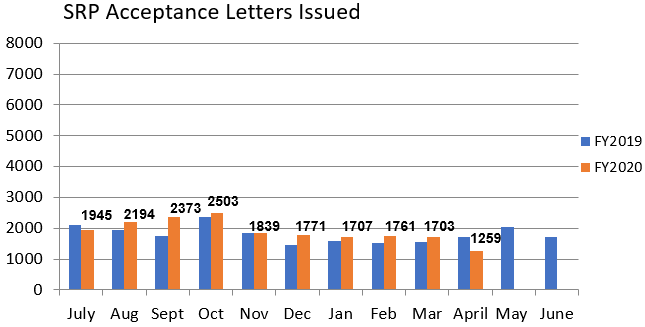
- SRP Registrations are being reviewed by the SRP Processing Team within 4-5 days from the date the registration is submitted in the online portal.
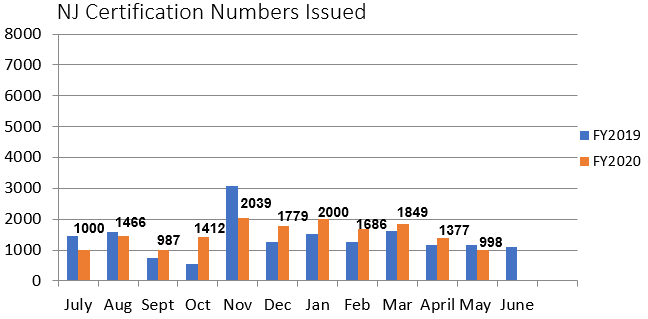
- NJ Certification Numbers are being processed within 2-3 weeks from the date the Final As-Built is submitted. At this time Final As-Built packets submitted through June 04, 2020 are being processed.
How did New Jersey Become a Leader?
New Jersey’s Clean Energy ProgramTM was established in 2001. That year there were only six solar installations in the state. Since that time, New Jersey has established a model program and an integrated approach to solar development that includes:
- A strong Renewable Portfolio Standard (RPS) with a dedicated carve-out for solar generated electricity that has helped create sustainable demand and investor confidence in the market. Learn more.
- Excellent interconnection and net metering standards that have made it easier for projects to connect to the distribution system and be compensated for their contribution. Learn more.
- A SREC financing model that provides energy certificates and additional long term financing for those who invest in solar.
How do SRECs work?
Each time a solar installation generates 1,000 kilowatt-hours (kWh) of electricity, an SREC is earned. Solar project owners report the energy production to the Generation Attribute Tracking System (GATS). This reporting allows SREC’s to be placed in the customer's electronic account. SRECs can then be sold on the SREC Tracking System, providing revenue for the first 10 or 15 years of the project's Qualification Life.
The Clean Energy Act, signed by Governor Murphy on May 23, 2018, included the following provision: "For all applications for designation as connected to the distribution system of a solar electric power generation facility filed with the Board after the date of enactment of P.L. 2018 c. 17 (C. 48:3-87.8 et al.) the SREC term shall be 10 years." L. 2018, c. 17, 2(d)(3).
On October 29, 2018 the New Jersey Board of Public Utilities clarified the language above as follows: NJ SREC Update: Implementation of New 10-year SREC Term.
Electricity suppliers, the primary purchasers of SRECs, are required to pay a Solar Alternative Compliance Payment (SACP) if they do not meet the requirements of New Jersey’s Solar RPS. One way they can meet the RPS requirements is by purchasing SRECs. As SRECs are traded in a competitive market, the price may vary significantly. The actual price of an SREC during a trading period can and will fluctuate depending on supply and demand. See recent SREC trading prices.
What is the SREC tracking system?
All solar energy systems eligible to earn SRECs must report system production based upon readings from a revenue-grade meter that meets the American National Standards Institute (ANSI) Standard C12.1-2008. This meter is in addition to the electric meter installed by the local utility to measure the home or business’ electric consumption. On May 1, 2012, the New Jersey Board of Public Utilities (BPU) re-adopted Chapter 8 rules with amendments that became effective on June 4, 2012. In re-adopting N.J.A.C. 14:8-2.9(c), the Board eliminated the use of production estimates for systems with a capacity of less than 10 kW. The revenue-grade meter must be installed by November 30, 2012. Following that date, SRECs will be issued to systems based only upon readings obtained from a revenue-grade meter measuring the system output. See NJ Administrative Code.
Once your solar project has been installed and your online SREC Tracking System account has been established, SRECs will be deposited in your account. The SREC Tracking System also records the sale of SRECs from generators to purchasers.
New Jersey's Clean Energy Program uses the SREC Tracking System GATS (Generation Attribute Tracking System), developed and supported by PJM Environmental Information Services (PJM-EIS).
Call 866-NJSMART (866-657-6278) for more information on NJCEP or 877-750-GATS (4287) for information on the PJM-EIS SREC Tracking System.